
Leo set his laptop down on the table between us and spun it around so I could see the screen. He’s been exporting industrial valves for eight years—not a massive operation, but solid. Reliable. The kind of business that doesn’t make headlines but pays mortgages and sends kids to college.
For the past three months, though, his main product listing for a stainless steel ball valve had tanked. Inquiries on Alibaba International dropped from forty-something a month to barely a dozen. And he had no idea why.
“I didn’t change anything,” he said, scrolling through the page. “Same photos. Same description. Same price. It’s like I just… went invisible.”
I scrolled further down. His product was buried on the third page of results. “Did you touch the title recently?”
Leo paused. That pause told me everything.
“I went to a workshop last month,” he admitted. “The guy said keywords should be arranged by search volume, highest first. So I moved ‘Stainless Steel’ to the front. My old title was ‘Industrial Ball Valve Stainless Steel 2 Inch’—”
“And now?”
“‘Stainless Steel Industrial Ball Valve 2 Inch.’”
I closed the laptop and slid it back toward him. “That’s exactly where it went wrong. You didn’t just rearrange words. You rewired how the platform understands what you’re selling.”

“Isn’t putting high-volume keywords first a best practice?”
Leo frowned at me the way a lot of seasoned sellers do when their instincts clash with new information. Ten years ago, when I was a sourcing director for a European industrial brand, one of my junior buyers asked me something similar. She couldn’t figure out why German clients searching “hydraulic hose high pressure” found our listing instantly, but typing “high pressure hydraulic hose” pulled up competitors instead.
“Let me ask you something,” I said. “How do your customers actually search?”
“They search for products. Valves, ball valves, stainless steel ball valves—”
“Stop right there,” I said. “Imagine you’re buying a valve right now. You type ‘ball valve’ into the search bar. You get fifty thousand results. What do you do next?”
He thought for a second. “I add parameters. Size, material, pressure rating, connection type.”
“Exactly. You narrow it down with specifics. But here’s the thing—your buyer doesn’t always have the full product name in their head. Sometimes they just know the problem. ‘I need a corrosion-resistant valve for this pipeline.’ So they search ‘stainless steel valve’ or ‘corrosion resistant ball valve.’ They’re describing a need, not naming a product.”
“So putting ‘Stainless Steel’ at the front should be perfect then, right?”
“It gets you into a much bigger pool,” I said. “But you’re not the big fish in that pool. Your actual product is an industrial ball valve. The core purchase-intent term is ‘Industrial Ball Valve.’ When that phrase led your title, the platform knew exactly what category you belonged to. Now that you’ve pushed a material attribute to the front, the algorithm starts treating your listing as a stainless steel product—which could be a gate valve, a butterfly valve, a check valve. Your identity became fuzzy.”
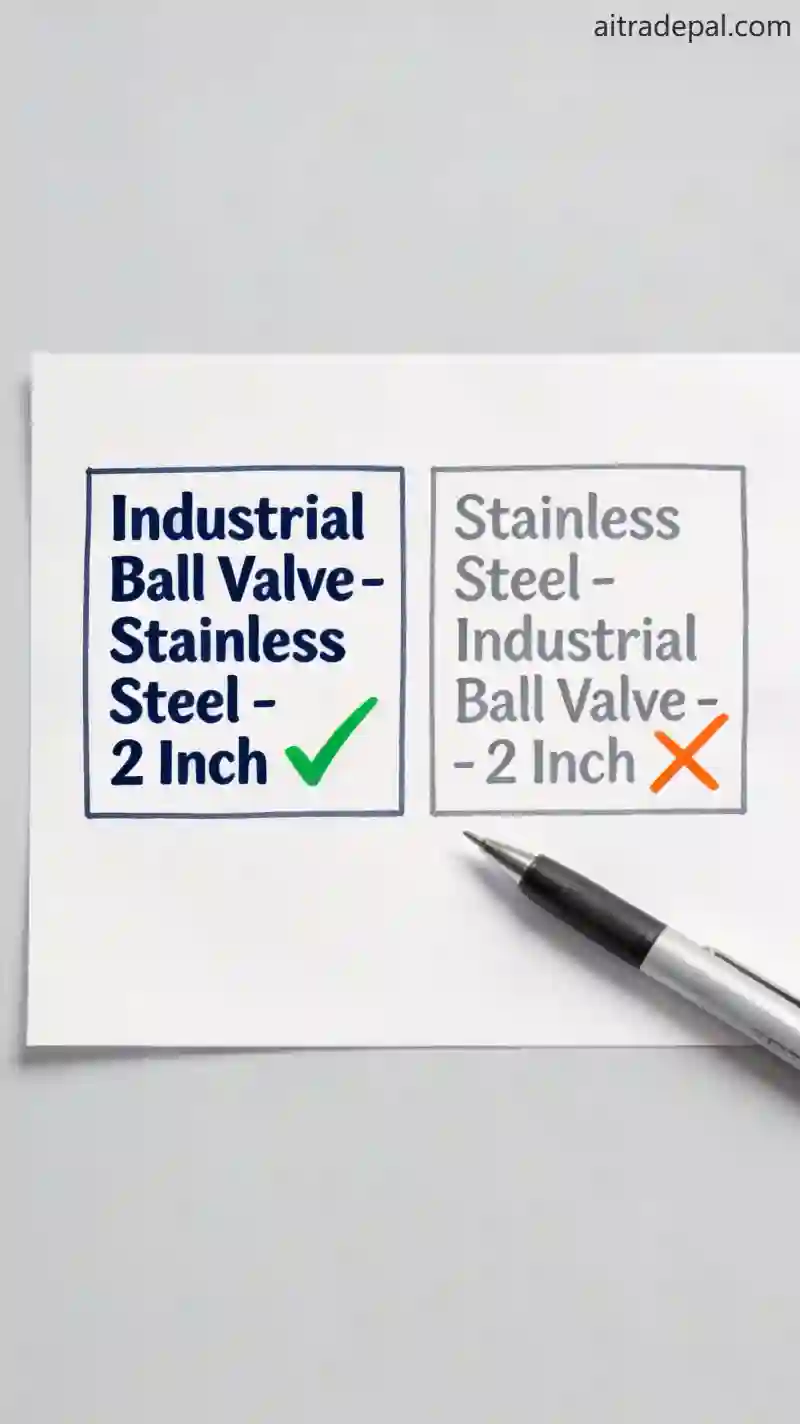
Your title isn’t a display case. It’s a street address.
I grabbed the notepad on the table and drew two boxes.
In the first box: Industrial Ball Valve - Stainless Steel - 2 Inch In the second: Stainless Steel - Industrial Ball Valve - 2 Inch
“Read these. What do you see?”
Leo stared at them. “They’re… just in a different order.”
“And to a human buyer skimming a results page, that difference means nothing. Both say the same thing. But to the search system?” I tapped the second box. “These are two different addresses. The platform assigns heavier weight to terms that appear earlier in the title. Your old title told the system: This is an industrial ball valve. One of its attributes is stainless steel. Your new title says: This is a stainless steel product. One of its types is an industrial ball valve.”
“Does that really make a measurable difference?”
“Huge difference. Your original title placed you in a pool of maybe twenty thousand monthly searches, but you were top three. Now you’re in a pool of two hundred thousand—and you’re on page five. Which position do you think generated more inquiries? You’ve been watching the numbers. You already know the answer.”
Leo was quiet for a moment, pulling the notepad closer. “So the core keyword always goes first?”
“It’s not that mechanical,” I said. “The real question is: which term represents the strongest purchase intent? For your valve, people are buying the function—it’s a ball valve for industrial use. Stainless steel is a decision factor, not a search entry point. But if you’re selling raw stainless steel sheets, then ‘Stainless Steel Sheet’ absolutely belongs at the front, because the material itself is the product. Context is everything."
"How do I figure out which word is the real core term?”
“Two signals,” I said, holding up my fingers. “First, can that word stand alone and still represent exactly what you’re selling? ‘Industrial Ball Valve’ on its own clearly identifies the product category. ‘Stainless Steel’ on its own covers everything from kitchen sinks to surgical instruments. It’s a descriptor, not a category.
“Second, test the long-tail combinations. Take the terms you’re unsure about, craft three to five title variations, and run them through a tool that analyzes search intent alignment. You’re not looking for a human’s opinion—you’re looking at how a model trained on platform search behavior classifies each version. If two titles get tagged with different product categories, you’ve got a title order problem.”
Leo pulled out his phone. “What tool would you use for that?”
“The one we built for exactly this kind of thing,” I said. “The AI trade copywriting tool has a product title optimization feature. Paste in your current title and your old one. It breaks down word order, term frequency, and purchase intent weighting, then recommends the sequence that actually aligns with how your target platform interprets search queries.”
I leaned back. “Had a client in LED lighting last month. He was wrestling with whether ‘Waterproof’ or ‘Industrial Lighting’ should lead his title. The tool showed him that his actual inquiries came from people searching ‘industrial lighting’ paired with specific application scenarios—not from generic ‘waterproof’ searches. He flipped the order, and within a week his rankings stabilized in the top eight.”

“Won’t changing my title mess up the ranking authority I’ve built?”
“That’s the question I was hoping you’d ask,” I said, and I meant it.
“You don’t want to rewrite titles every week. But you absolutely need to know which words are load-bearing and which ones are quietly working against you. Keyword order in product titles shapes your foundational positioning signal. If your actual core term gets pushed to the fourth position or beyond—crowded out by secondary attributes—the platform’s understanding of your listing drifts. This isn’t about losing authority. It’s about being miscategorized at the root level.”
Leo’s expression shifted. “So my ranking authority isn’t gone. I just repainted my storefront sign with someone else’s colors.”
“Exactly. All the authority you spent a year building is still there. But it’s pointing toward the wrong classification. You don’t need to rebuild authority. You need to correct the address.”
I checked the time and added one more thing. “Run a title diagnostic before you make any manual changes. Don’t guess. When you swap the order of two words, you’re essentially reissuing your product’s identity document. Whether that document gets your product in front of the right search path depends on data, not gut feeling.”
Leo closed his notebook. The tension in his face had softened. As he stood up to leave, he turned back with one last question.
“How fast will I see results after I fix it?”
“Three or four days if you’re lucky, two weeks if you’re not. Once the system recrawls and reinterprets your title, it’ll recognize that you’ve finally come home. Those inquiries that disappeared? They’ll find your door again.”
I watched him walk out. He had that look—the one sellers get when they realize the problem wasn’t a penalty, wasn’t a competitor, wasn’t the algorithm working against them. It was something they could fix in five minutes. They just needed to know what to look for.
📝 Originally published on AI Trade Pal Blog
🔗 Original link: https://aitradepal.com/blog/en/product-title-keyword-order-en-572
📄 Reproduction must retain original link. Modification for commercial use is prohibited.