
I still remember that morning.
January 16, 2026. A Thursday. I opened Seller Central like I’d done a thousand times before, coffee in hand, ready to check the previous day’s numbers.
The page loaded. I stared at it. Then I refreshed. Then I refreshed again.
Three of my top ASINs had lost almost 70% of their sessions overnight.
Not a gradual dip. A cliff. I went to the front end and searched my core keyword — the one I‘d been ranking top five on for two years. Page three. Nothing. Page four. Nothing. Page five. Gone.
My first thought: someone’s sabotaging me. A hijacker. A false complaint.
I checked everything. Nothing.
Then this sinking feeling hit me. The week before, I’d seen some chatter in a seller group about Amazon’s 2026 title rules. Something about keyword stuffing triggering direct suppression. I’d scrolled past it. Because I figured — my titles were fine.
They weren’t.
I thought my title was textbook. It was actually a landmine.
I sell a silicone baking mat set in the Kitchen category. Three years on the listing, 2,000-plus reviews, 4.5 stars. The core keyword “silicone baking mat” had been sitting comfortably on page one, top five, for as long as I could remember.
To protect that ranking, I did something at the end of 2025 that seemed smart at the time: I “optimized” the title.
The original looked something like:
ChefTop Silicone Baking Mat Set, Non-Stick Pastry Mat for Baking, Oven Safe Cookie Sheet Mat, 2-Pack
But I thought it wasn‘t enough. So I went into my keyword tool, pulled every high-volume search term I could find, and stuffed every last one of them in:
ChefTop Silicone Baking Mat Set, Non-Stick Silicone Pastry Mat for Baking, Oven Safe Cookie Sheet Mat, Reusable Bakeware Mat, BPA Free Baking Supplies, 2-Pack, Gray
I was proud of myself. Look at that — core terms, long-tail terms, attribute terms, all packed into a tight 200 characters. Every inch of real estate used.
Then January 16 happened. And Amazon showed me, in the most brutal way possible, that I hadn’t written a title. I‘d written a pile of garbage the algorithm could no longer read.
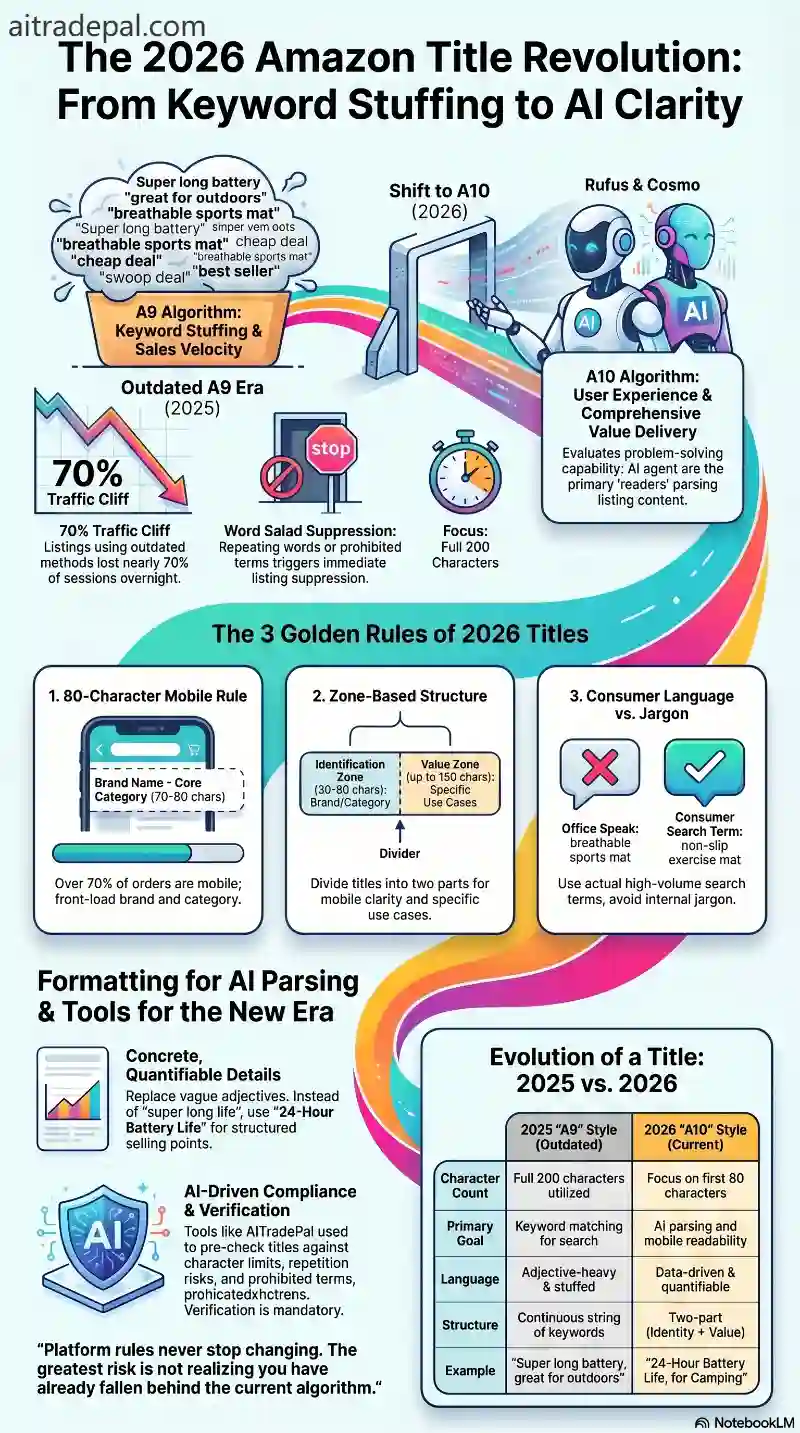
It took me a while to piece together what had actually gone wrong. The core logic of Amazon’s search algorithm had fundamentally shifted from 2025 to 2026. The old A9 system was built on keyword matching plus sales velocity — you stuffed the right words in, you pushed volume, you ranked. But the new A10 algorithm has moved its entire weight behind user experience and comprehensive value delivery. It doesn‘t just look at how much you sell anymore. It evaluates how well your product solves actual customer problems[reference:8].
And here’s the part most sellers still haven‘t absorbed: the title is no longer a “keyword entry point” for A9. It’s the primary information source that Amazon‘s AI agents — Rufus, Cosmo — use to understand your product[reference:9]. If your title reads like a chopped-up word salad that no human and no AI can parse, the system marks it as low-quality content and simply won’t surface you.
Put another way: the “optimization” I did in late 2025 looked, to the 2026 algorithm, like self-sabotage.
11 suppressions later, here‘s what the bloodbath taught me.
Over the next two months, I went into a frenzy. I rewrote 37 ASIN titles. Eleven of them got suppressed. I stopped counting how much revenue I burned through in the process.
But every time a title got slapped down, I did one thing: I pulled the before-and-after data. Session counts. Keyword rankings. CTR. And slowly, painfully, patterns started to emerge.
Lesson one: 80 characters, not 200.
Amazon says the title limit is 200 characters. And technically, that’s true — for most categories. But here‘s what they don’t shout about: on the mobile app, search results show roughly the first 70 to 80 characters of your title before it gets cut off[reference:10]. And more than 70% of Amazon orders now come from mobile[reference:11].
So when you spend 200 characters crafting what you think is the perfect title, the majority of your potential buyers only ever see the first third of it.
Whatever you need a shopper to understand immediately — who you are, what you sell, what makes it worth clicking — has to live inside those first 80 characters. Everything after that is bonus territory. Crucial, yes. But not the opening act.
Lesson two: Split your title or suffer.
Amazon has been pushing toward a two-part title structure throughout 2026. It‘s not mandatory in every category yet, but the direction is unmistakable: titles need to be layered, logical, and instantly legible to AI[reference:12].
The first part — I call it the “identification zone” — should run about 30 to 50 characters. One job only. Tell the system what you are selling. Brand name, core category term, key attribute. Clean. No fluff.
The second part is the “value zone,” topping out around 150 characters. This is where you talk function, use cases, and what actually differentiates your product from the sea of competitors. And the rule here is ironclad: use specific, quantifiable details instead of vague adjectives[reference:13].
Before, I’d write “super long battery life.” Now I write “24-Hour Battery Life.” Before, “great for outdoors.” Now, “for Camping, Hiking & Outdoor Travel.” The system strongly prefers concrete, judicable information because it directly supports buyer decisions — and because Rufus can actually extract structured selling points from it[reference:14].
Lesson three: Stop speaking your internal team language.
This one stung.
Inside our team, we‘d been calling one product a “breathable sports mat” for almost a year. Development called it that. Operations called it that. It felt completely natural. So naturally, I slapped it into the title.
Then I finally checked the Search Term Report. American buyers don’t search for “breathable sports mat.” Not one of them. They search for “non slip exercise mat,” “gym floor mat,” “workout mat for home.”
I had put a term in my title that only made sense inside my own office. And I expected it to drive traffic. That‘s not marketing. That’s talking to yourself in public. The most insidious traffic killer on Amazon isn‘t a competitor — it’s sellers unconsciously swapping consumer language for internal jargon[reference:15].
I still can‘t do this manually at scale.
Alright, so I’ve laid out the lessons. Now here‘s the part where I get honest about what actually happens when you sit down to implement all of this.
It’s overwhelming.
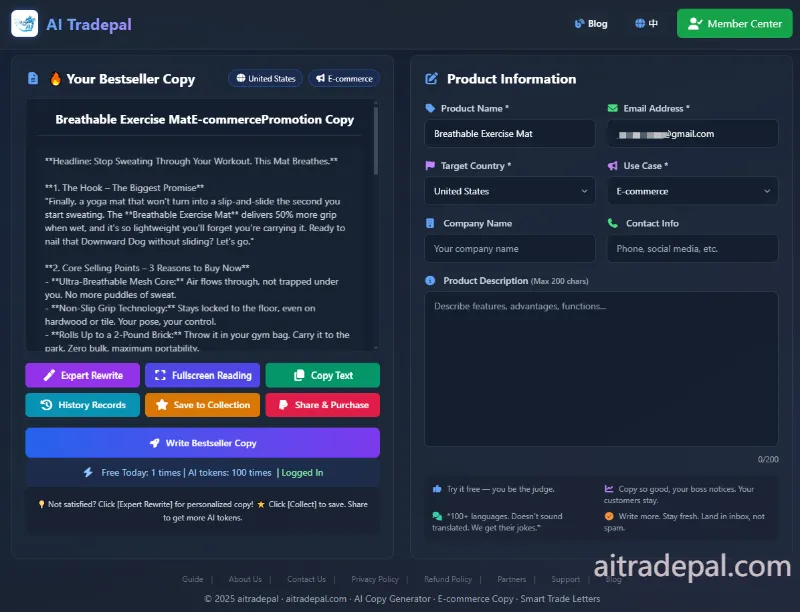
Because you‘re not dealing with one title. You’re managing dozens, maybe hundreds of ASINs. Every single one needs a title that hits the new rules, reads naturally, covers the right keywords, and avoids the landmines that trigger suppression. That‘s not a “roll up your sleeves and grind it out” problem. That’s a workflow bottleneck that costs you money every day you delay.
And then there‘s the verification hell. Did you accidentally repeat a word more than twice? Did a banned promotional term sneak in? Is your primary benefit actually visible before the mobile truncation point? Does the whole thing still look coherent when it’s cut off mid-sentence on a phone screen?
Any one of those details can get you suppressed. And I‘ve been suppressed 11 times now. I am not in the mood for number 12.
Here‘s what I do now. I draft the title. Then I run it through an AI tool — but not just any AI. A generic chatbot doesn’t know Amazon‘s banned word list. It doesn’t understand Rufus‘s parsing logic. It has no clue where mobile truncation kicks in or that repeating a non-article word more than twice is a compliance risk. You need something purpose-built for this exact task.
The tool I use is called AITradePal. It‘s designed specifically for Amazon listing copy, and it has the 2026 rules embedded right into the workflow — character limits, prohibited terms, semantic readability checks, mobile preview, the whole stack. You feed it your product info and core keywords, and it generates multiple title variants in seconds, all pre-checked against Amazon’s latest compliance requirements. I use it for Amazon title keyword optimization across my entire catalog now, and the difference in turnaround time is honestly staggering.
If I‘d had this in December 2025? Those 11 suppressions probably never happen.
One last thing.
I’ve been selling on Amazon for eight years. The biggest lesson I‘ve learned — the one that keeps humbling me — is that platform rules never stop changing. And the greatest risk isn’t that you fail to keep up with the changes. It‘s that you don’t realize you‘ve already fallen behind.
The core logic of Amazon titles in 2026 comes down to this: you are no longer writing for a keyword-matching algorithm. You’re writing content that AI agents and real humans need to understand, simultaneously. The sellers who nail clarity, who structure their titles so Rufus gets it instantly, who put their most decisive information in those first 80 mobile characters — those are the ones who survive this game.
If you‘re still writing titles the 2025 way — stuffing keywords, ignoring structure, letting internal jargon sneak in — go check your Seller Central right now. Look at your organic sessions. Look closely.
Don’t wait for the cliff.
I did. And those lost weeks of revenue? They don‘t come back.
Written by a seller who’s been in the Amazon trenches for 8 years, made more mistakes than he can count, and is still learning every single day.
📝 Originally published on AI Trade Pal Blog
🔗 Original link: https://aitradepal.com/blog/en/amazon-title-keywords-2026-en-583
📄 Reproduction must retain original link. Modification for commercial use is prohibited.