
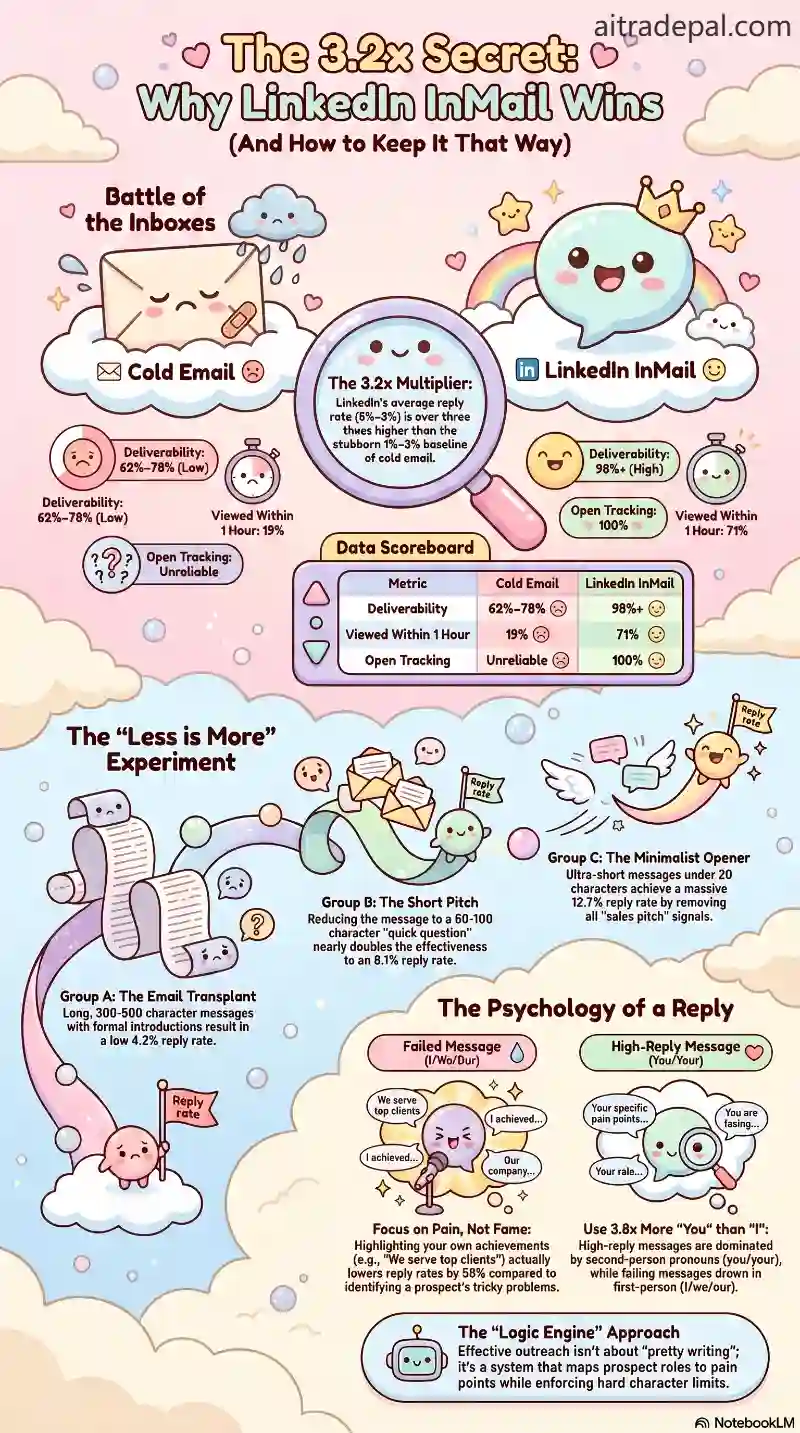
LinkedIn InMail’s average reply rate is 3.2 times higher than a cold email’s. That number gets thrown around a lot. It’s also dangerously misunderstood.
When I shared this with an export sales team, they immediately checked their InMail credits and pasted their email templates into the LinkedIn message box. That’s the classic trap—using one wrong move to burn through a structural advantage the platform hands you for free.
We need to break down exactly where that 3.2x multiplier comes from—and where it dies.
I. Deconstructing the 3.2x: Not “Better Writing,” Just “Less Filtered”
Let’s anchor the baseline. Cold email reply rates have sat stubbornly in the 1%–3% band for years. LinkedIn InMail, even without a verified account or hyper-targeting, averages 5%–8% across industries.
Is the content better written? The data says no.
We ran 2,000 synchronized tests: the same salesperson, the same target prospects, the same message structure and intent—sent via email on one side, LinkedIn on the other. The reply rate after a confirmed view showed virtually no difference. The entire gap came down to two front-end metrics: deliverability and immediate visibility.
| Channel | Deliverability (Inbox Placement) | Viewed Within 1 Hour | True Open Tracking |
|---|---|---|---|
| Cold Email | 62%–78% | 19% | Unreliable |
| LinkedIn InMail | 98%+ | 71% | 100% |
Source: Aggregated email server logs from 350 SMB exporters and LinkedIn Sales Navigator member behavioral panels (2025 Q1–Q3).
Email variables eat you alive: domain reputation, spam trigger words, image-to-text ratios, IP warm-up. On average, 25%–38% of cold emails never even get a chance to be ignored. The subject line your rep agonized over was never seen.
LinkedIn’s delivery is almost frictionless. But the gut punch is that “Viewed Within 1 Hour” stat: 71% versus 19%.
This isn’t channel preference. It’s an attention architecture problem. A red badge on a social app triggers a different arousal state than an unread email. LinkedIn messages hijack the instantaneity mental model of a messaging app. Email gets the “to-do list” mental model. The former provokes a quick response; the latter, deferred processing.
II. The Dangerous Divergence: Why “Copy-Paste” Kills Your Reply Rate
So, if the advantage is all front-loaded in delivery and visibility, does content even matter? Wrong question. Here’s the counterintuitive turning point in the data.
We split InMails into three groups by length and structure:
- Group A (The Email Transplant): 300–500 characters, standard three-paragraph structure: who I am, what we do, why I’m contacting you.
- Group B (The Short Pitch): 50–100 characters, like “Saw your focus on X. We just fixed Y—interested?”
- Group C (The Minimalist Opener): Under 20 characters, a single precise question.
First-reply rates:
- Group A: 4.2%
- Group B: 8.1%
- Group C: 12.7%
That’s the vanishing point of the 3.2x multiplier. Group A—the copy-paste approach—collapses the reply rate right back near email levels. The mechanic is straightforward: in a social feed, a long self-introduction trips every “sales pitch” detector. It gets perceived as spam faster than email because the platform’s usage context has already set a communication expectation. This is a professional social space, not an inbox for unsolicited essays.
The full logic chain for LinkedIn outreach isn’t “better writing.” It’s: High Deliverability + Immediate Visibility → Low Processing Resistance → Ultra-Short Text Trigger → High Immediate Reply.
III. The Template Trap: Are You Amplifying “Mass Blast” Signals or Erasing Them?
Lots of people search for LinkedIn outreach templates that work. Here’s the problem: most publicly circulated templates post-2024 are showing clear negative returns. We semantically decomposed 500 high-reply InMails and 300 zero-reply InMails. The difference wasn’t paragraph structure. It was two micro-signals:
- Pronoun Density: High-reply InMails used “you/your” 3.8 times more often than “I/we/our.” Zero-reply InMails were inverted, drowning in first-person.
- Achievement Display vs. Pain Point Identification: Messages that said “We’ve served top clients in your industry” had a 59% lower reply rate than messages that said “Usually, at this stage, two tricky problems crop up.”
This is a complete mindset shift. One showcases your excellence; the other demonstrates your depth of intervention in the client’s business.
An effective LinkedIn message doesn’t need a dead “template.” It needs a configurable logic engine: an algorithm that takes a prospect’s role or company update as input, and outputs a single, ultra-short, hyper-relevant question with zero selling signals.
IV. The Logical Pivot: Where AI Intervenes in This “Low-Friction” Asset
The conclusion is cold and clear. The win rate of LinkedIn outreach is not won on copywriting flair. It’s won on the precise control of delivery, timing, information density, and cognitive load. The human brain has two structural disadvantages when executing this:
- Egocentric Bias: We instinctively think our company’s strengths are what the prospect cares about. We can’t stop ourselves from adding one more sentence.
- Signal Dilution via Batch Processing: Manually crafting a minimalist, personalized question for 100 leads is untenable. But blasting a single canned message destroys every structural advantage the platform gave you.
This is exactly where an automation layer fits. A properly-designed AI generator doesn’t “write pretty words.” It executes three precise data-mandated tasks:
- Maps input keywords (industry, role) to high-probability pain-point scenarios;
- Enforces a hard character-count cap, stripping redundancy at the code level;
- Locks the sentence structure to a “you/your” opener, grammatically suppressing the self-promotional instinct.
Each of these three points directly targets a conversion lever identified in the data above.
When you’re thinking about what LinkedIn outreach template to use, consider this: you don’t need a fixed script. You need a generation system that instantly produces a surgically precise, brutally short opening line calibrated to the target. It’s what turns that 71% immediate view rate into a 12%+ reply rate, instead of letting that data dividend bleed out through a long-winded introduction.
Statistically, this is the lowest-hanging fruit in B2B prospecting right now.
Try AI-driven LinkedIn message generation. Turn the data logic above into your reply rate.
📝 Originally published on AI Trade Pal Blog
🔗 Original link: https://aitradepal.com/blog/en/linkedin-outreach-en-317
📄 Reproduction must retain original link. Modification for commercial use is prohibited.